
About Rokita

Rokita is a contemporary Puerto Rican artist living and working in Pittsburgh, PA. She graduated from the University of Connecticut in 2015 with a BA in Art History, and from the University of Pittsburgh in 2016 with an MA in Library & Information Science. She worked as the Fine Arts Librarian at Pitt for nearly 5 years as she worked on establishing her art practice, which she currently makes a living from.
Through her work, she hopes to illuminate the vital intersection of mapping, indigenous knowledge, and environmental stewardship, using creativity as a tool for advocacy and change. She aims to inspire a deeper connection to the planet and to one another - fostering a dialogue about ecological challenges, amplifying diverse voices and indigenous knowledge, and challenging systems that perpetuate both environmental degradation and gender inequality.
Rokita draws inspiration from the relationship that humans have to place and space, imaginary or real. She loves creating abstract maps of imaginary places, and at times, incorporates physical and visceral perceptions of places that hold meaning or have changed or eroded due to climate change, or are in danger of being lost or destroyed. She is also heavily inspired by patterns found in the natural world; the infinite details of lichen, the texture of kelp, the rivers of Iceland seen from above. Nature provides endless inspiration.
Rokita is also interested in how her work might inspire viewers to find their inner compass and find joy in visual exploration.
Rokita's preferred mixed-media mediums are watercolor, inks, gold leaf, and thread. Having developed her unique style over the past 10 years, Rokita has found that adding thread as a final touch lends a greater feeling of direction and texture to her pieces. Gold ink or gold leaf are also used heavily in her work, inspired by artists like Klimt and the great book artists of the Middle Ages, who similarly loved making imaginary maps and using gold accents.
*In 2026, Rokita is creating art about symbiosis in nature and surviving / thriving under challenging conditions. Her current muse is map lichen.
Past Art Gallery & Art Show Features:
The Ferleman Gallery in Maryland
CURIO Art Gallery & Studio in Zelienople
Superfine Art Fair in Washington, DC
Partners:
The Women's Earth Alliance
Awards:
Carnegie Library of Pittsburgh Hispanic and Latin Heritage Month Artist, 2026
Press:
Signs of Life at Ferleman Gallery
Seguimos Aquí Documentary
Art Seen Magazine Spotlight (May 2026)
PORTFOLIO

'Where the Current Holds' - Watercolor & Gold Leaf on Canvas. 16x20. Available.
Some of the quietest things in nature are also the most resilient.
While researching for my latest work, I fell down a rabbit hole about map lichen, those delicate, branching patterns that slowly spread across stone. At first they seem fragile, almost decorative. But they’re actually one of nature’s great survivors.
Scientists have found that map lichen can endure the raw conditions of outer space for 15 days, and survive radiation levels 12,000 times higher than what would be lethal to humans.
What looks soft and quiet is, in truth, extraordinarily strong.
Even more beautiful is how it survives: through symbiosis. Lichen is not one organism but a partnership: different life forms working together so that each can thrive where none could alone.
That idea has stayed with me while I create my latest work.
‘Where the Current Holds’ is just one translation of those patterns - of resilience, connection, and the quiet ways life persists even in the harshest environments. It’s a reminder that endurance doesn’t always look loud. Sometimes it looks like small networks holding each other up.
Nature is full of these lessons, and I love bringing them into my work, where science, story, and paint meet.

'Mutual Cartography' - Watercolor & Gold Leaf on Canvas. 16x20. Private Collection in Illinois
For this piece, I was very inspired by 'map lichen', which has been shown to survive symbiotically in harsh conditions, even in the arctic, for over 11,000 years. The oldest map lichen dates is around 11,500 years old.
For this piece, I was also thinking about our current moment in history. Symbiosis doesn't just concern lichen, or nature, or climate change. But also how we rely upon each other in community to love the earth better. And to love and protect each other better. This piece aligns with my theme for 2026: Symbiosis and surviving under challenging conditions.

'Universal Transcendence' - Watercolor, Ink, & Gold Leaf on Canvas. 16x20. Private Collection in California
"Universal Transcendence" can mean the idea that humanity (or consciousness) is capable of moving beyond narrow identities that include national, religious, economic, or even species-level ego, toward a state of awareness that recognizes deep interconnectedness with all existence. It's not just spiritual; it's ontological (a way of understanding that there's no separation between self, nature, and the cosmos). When viewed this way, transcendence is not escape from the world but re-integration with it.
In a time when many people feel disconnected, like they're "just here" or "just existing" - I think reframing out point of view around this can help tremendously. At the end of the day, climate change is a crisis of separation. It's arguably a symptom of disconnection; from ecological cycles and limits, from ancestral memory and indigenous stewardship of nature, and from the sense of sacred reciprocity between humans and the earth.
A transcendent consciousness challenges that separation by dissolving the illusion that human progress stands apart from planetary health. It asks us to experience Earth as subject rather than object: being alive, aware, ad responsive.
What to do: Build a relationship with nature. Again. Or for the first time. The more we personally care about nature, the more we'll want to act on the change it needs to thrive.

'Mary's Spring' - Watercolor, Ink, & Gold Leaf on Canvas. 16x20. Private Collection in New Mexico.
This piece was inspired by an image by a Connecticut photographer of native lichen clinging to a tree in a forest that I grew up hiking in as a child. As I processed the inspiration and expanded ideas on this piece with one of my collectors, she described how the green hues reminded her of springtime in Oregon, the native grasses being of such a stunning color that she has yet to see elsewhere. As humans, green is the one color our eyes are able to see the most shades of. With this piece, I incorporated three hues of green, in addition to some blues, to create depth of perception that the human eye could appreciate, while paying homage to the complex structures of lichen.

'Calichi' - Watercolor, Ink, & Thread on Canvas. 16x20. Private Collection in California.
This painting is part of my ongoing Island of Things Collection. With this collection, I’m carrying out research on my indigenous Taino (indigenous Puerto Rican) roots. As I gather and reflect on family oral histories, symbols of the Taíno, folktales, and written histories about the myth of their extinction, I’m more and more inspired to create these works.
Most paintings in my Island of Things collection reference the spiral motif, which is a universal symbol but for the Taino represented the complete cycle of life, and one’s personal journey through life. In mapmaking at the most basic level, we chart the paths we take across land. In my work, I envision the spiral symbolizing inner journeys, collective ancestral memory, or spiritual migration, all maps of an abstract kind.
This painting also references Calichi, the name of a river in a Puerto Rican folktale about a girl who can speak the language of nature; a language that’s quickly being lost. In the story she can hear the river laughing as she follows it to her destinations. In the story, she talks about her "friends" who would keep her company. One of them is the stream, "who taught her to call her Calichi." I love the concept of learning from nature, listening to nature, and interacting with nature as a friend. The more we build relationships with nature, the more likely we are to take care of it.

'Eternal Love for Trees' - Watercolor, Ink, and Thread on Paper. 8x8. Private Collection in The Netherlands.
This painting was created as part of my Island of Things Collection. It references the "Eternal Lovers" petroglyph, typically shown as two birds with their beaks meeting. For the Taino it was a love scene, but is also wrapped up in their idea that everything they grew or killed belonged to the entire tribe. This motif takes on a bigger meaning when we think about it in context of how we should care for nature. This earth belongs to all of us, and we all have a responsibility to care for it.
For this specific painting, I was thinking about the sacred Ceiba trees, many of which were destroyed when Hurricane Maria devastated Puerto Rico. The Taino saw the Ceiba as the part of nature that connects us to heaven, earth, and the underworld. Many of these trees have come back since their devastation and stand as a testament to the hope of revitalization in the aftermath of climate change events.

'Map of Collective Memory' - Watercolor, Ink, and Thread on Canvas. 16x20. Private Collection in New Mexico.
I fully believe that one of the ways to save nature is through indigenous knowledge. Indigenous peoples are the original stewards of the land. They worked the land, before capitalism and Western colonialism. Their knowledge, although not always written down in a book or taught in school, I believe is just as important as learning subjects like history or physics.
As I worked on this painting, I was thinking about all of the collective indigenous knowledge and memory tied to the care of nature. I was thinking about how this knowledge and memory has flowed through time and generations, yet, for many of us seems unreachable (or is not at the forefront of how we learn to take care of nature).

'Caribbean Coral Reef' - Watercolor & Inks on Paper. 8x10. For 'Maps of the Earth We Still Have' - Private Collection in California
Over the years, I’ve watched as ecosystems I love (including those my indigenous ancestors held sacred) being scarred by pollution, droughts, hurricanes, fires, and floods.
I think as (good) humans, it’s our duty to document the world we still have, build a loving relationship with nature, and save what’s left. The best way I know how to engage with this work is through art. So here we are.
“Maps of the Earth We Still Have” is a multimedia art project that brings together a collection of abstract map paintings, songs, and poems that capture the fragile beauty and feeling of ecosystems we risk losing, while bringing awareness to their need for care.
Each "map" in the project represents one of the top 10 most endangered ecosystems such as coral reefs, kelp forests, springs, marshes, and estuaries. These are visualized as living emotional impressions through a mixed media collection of paintings that I've created, accompanied by songs by Baumarius (a synesthete and composer who also happens to be my little brother), and poems by Scott Thornton (one of my art-collectors-turned-creative-collaborator).
This painting was created for the Caribbean coral reef ecosystem. The Kickstarter for this project launched on December 16th, 2025. Although we did not hit our funding goal, the entire collection sold out and we have plans to do an interactive exhibition for the project in 2027. See the Kickstarter page here.
For this project, I'm writing short essays for each painting and ecosystem on my Patreon, where most posts are publicly available. Each is accompanied by suggested reading, videos, and suggested nonprofits to support. Read more here.

'Caguama' - Watercolor, Ink, & Thread on Canvas. 16x20
This painting was created as part of my Island of Things Collection. This painting references the turtle petroglyph, which represented the very origin of life, our connection to Mother Earth, fertility and motherhood. "Caguama" refers to the Taino word for a large sea turtle, and also represents the fertility Mother, or a supreme maternal figure in Taino mythology, with the entire continent of America once being called "Caguama" (Great Sea Turtle) Mother Island by Taino ancestors.

'SF:E No. 3' - Watercolor, Ink, & Thread on Paper. 8x8.
In the spring of 2025 I had a trip planned to San Francisco. In the lead up to my trip, I started researching the area and became fascinated with the San Francisco Estuary. This painting, along with 3 others, were inspired by the estuary and this painting in particular is meant to reflect on the oil spills that have taken place over the years that threaten the ecosystem as well as people who live along the coast.
Selected Art Prints
-

'Interstellar'
-
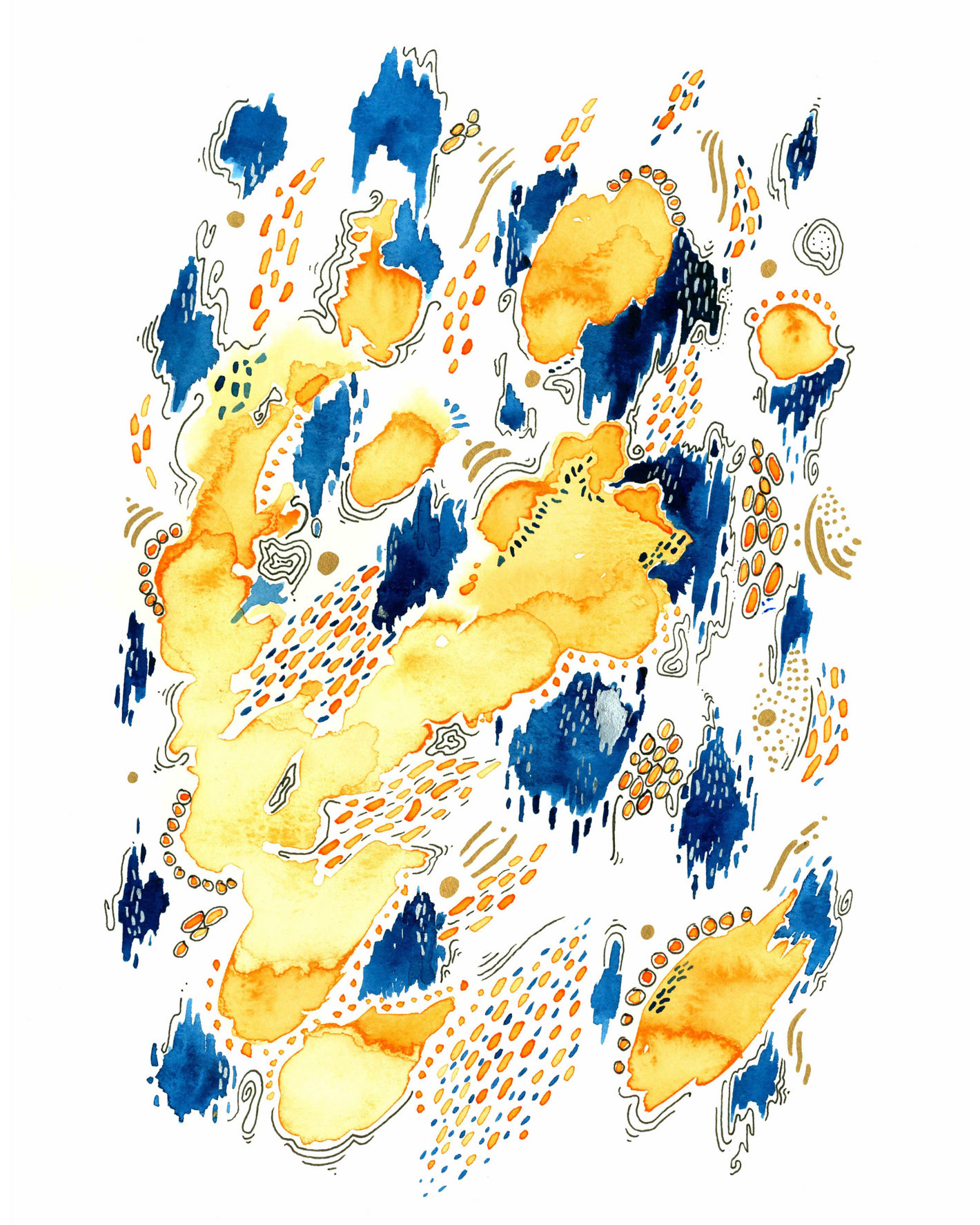
'Racing'
-
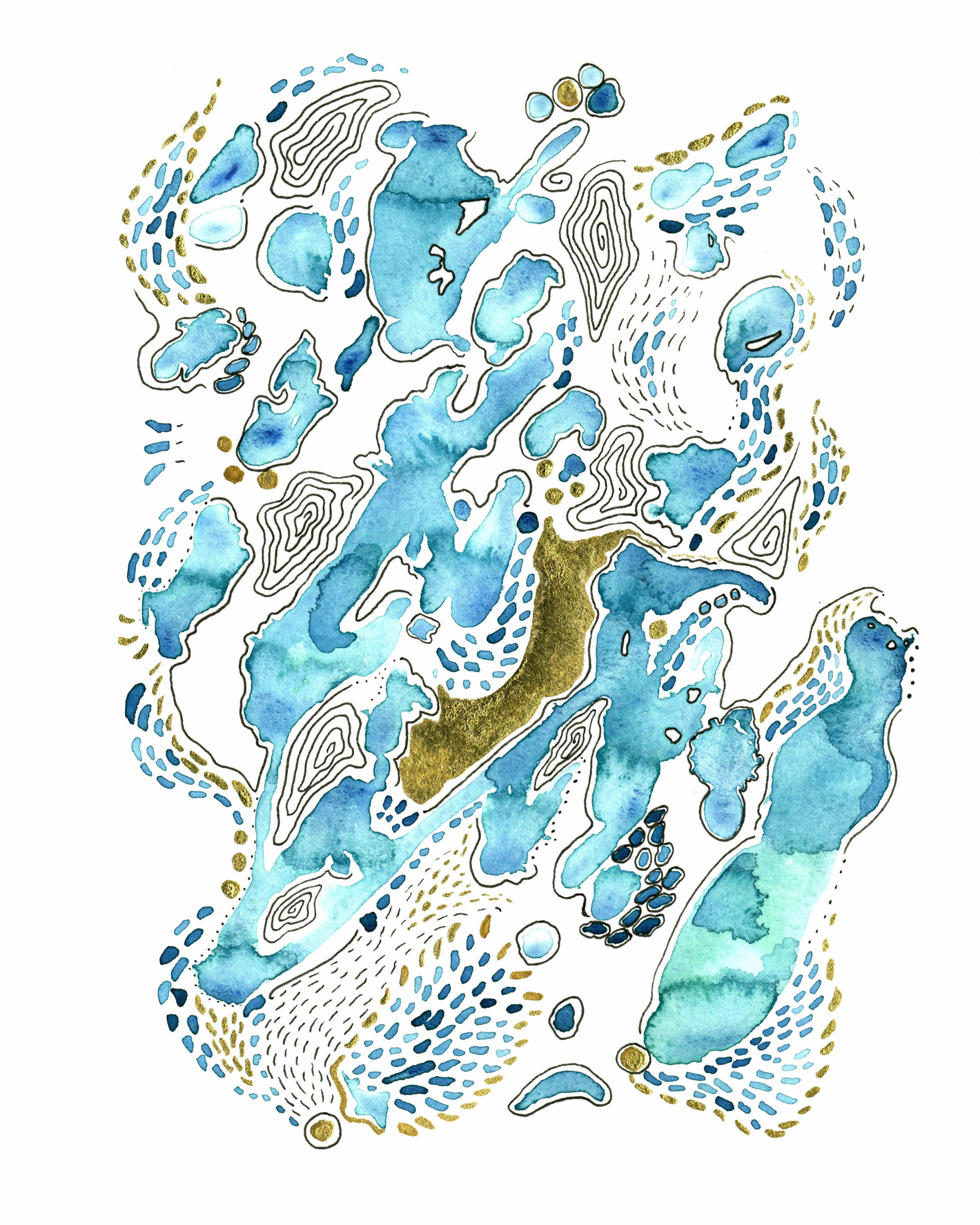
'Salty Seas'
-
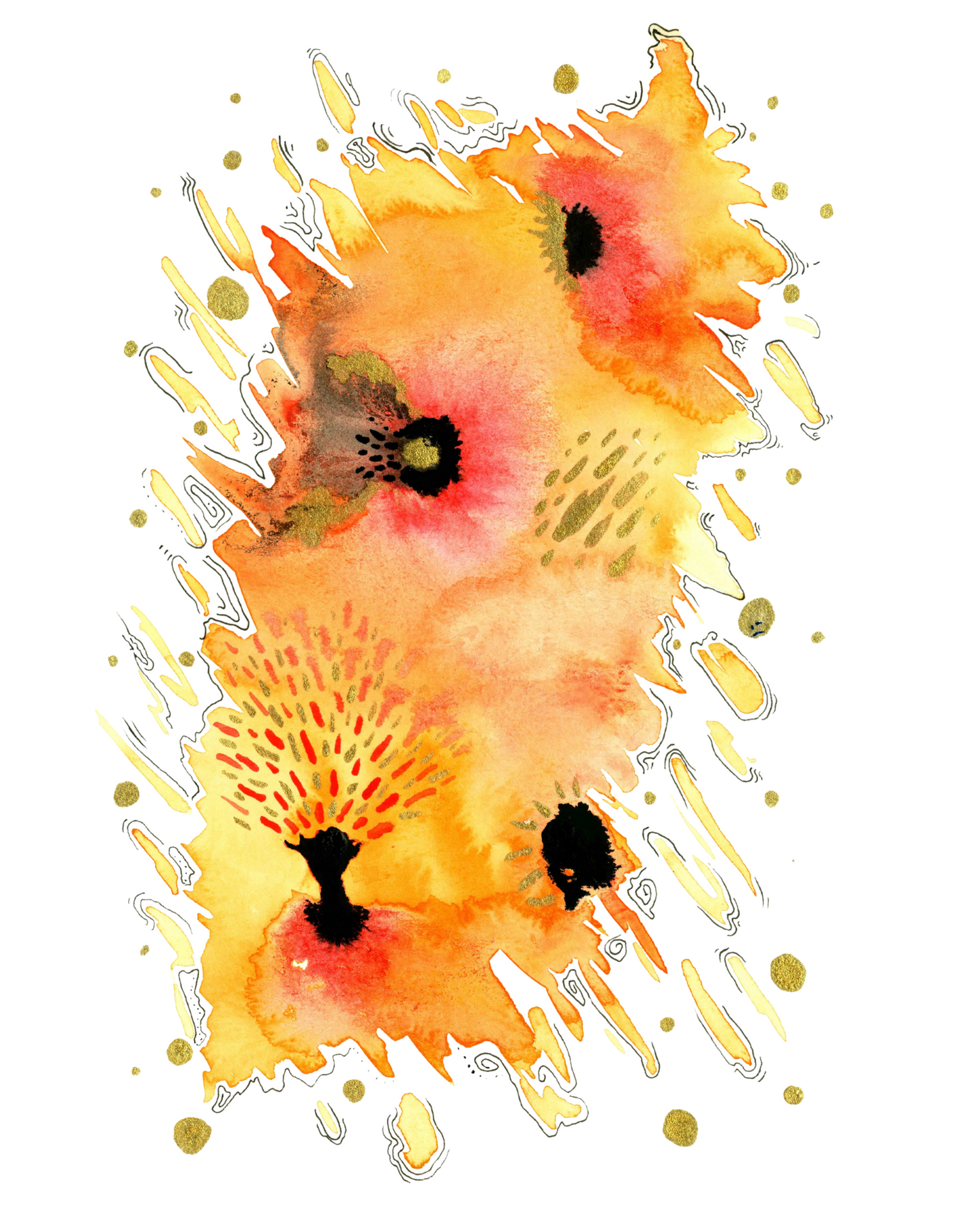
'Burst'
-
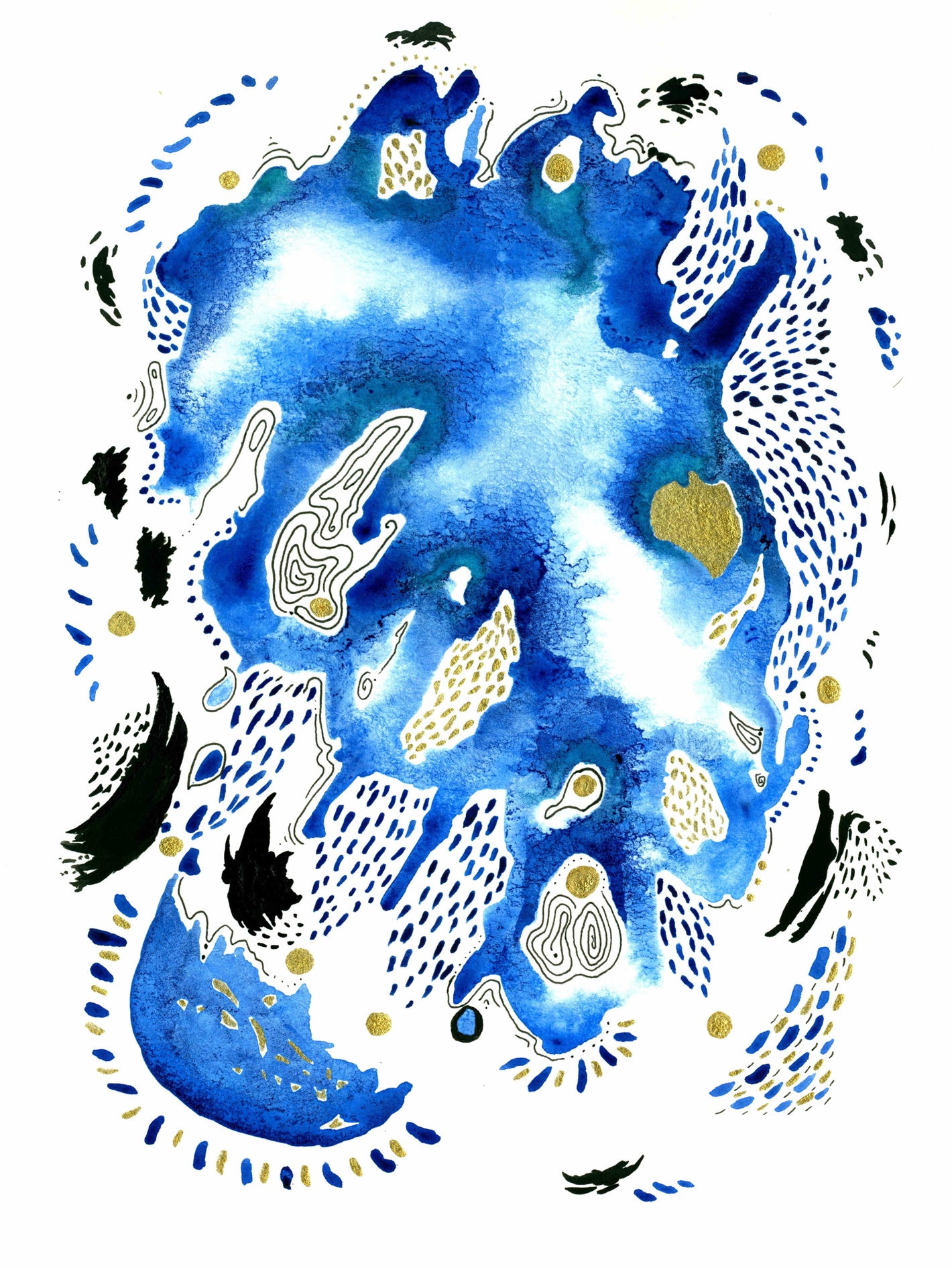
'Lagoon'
-
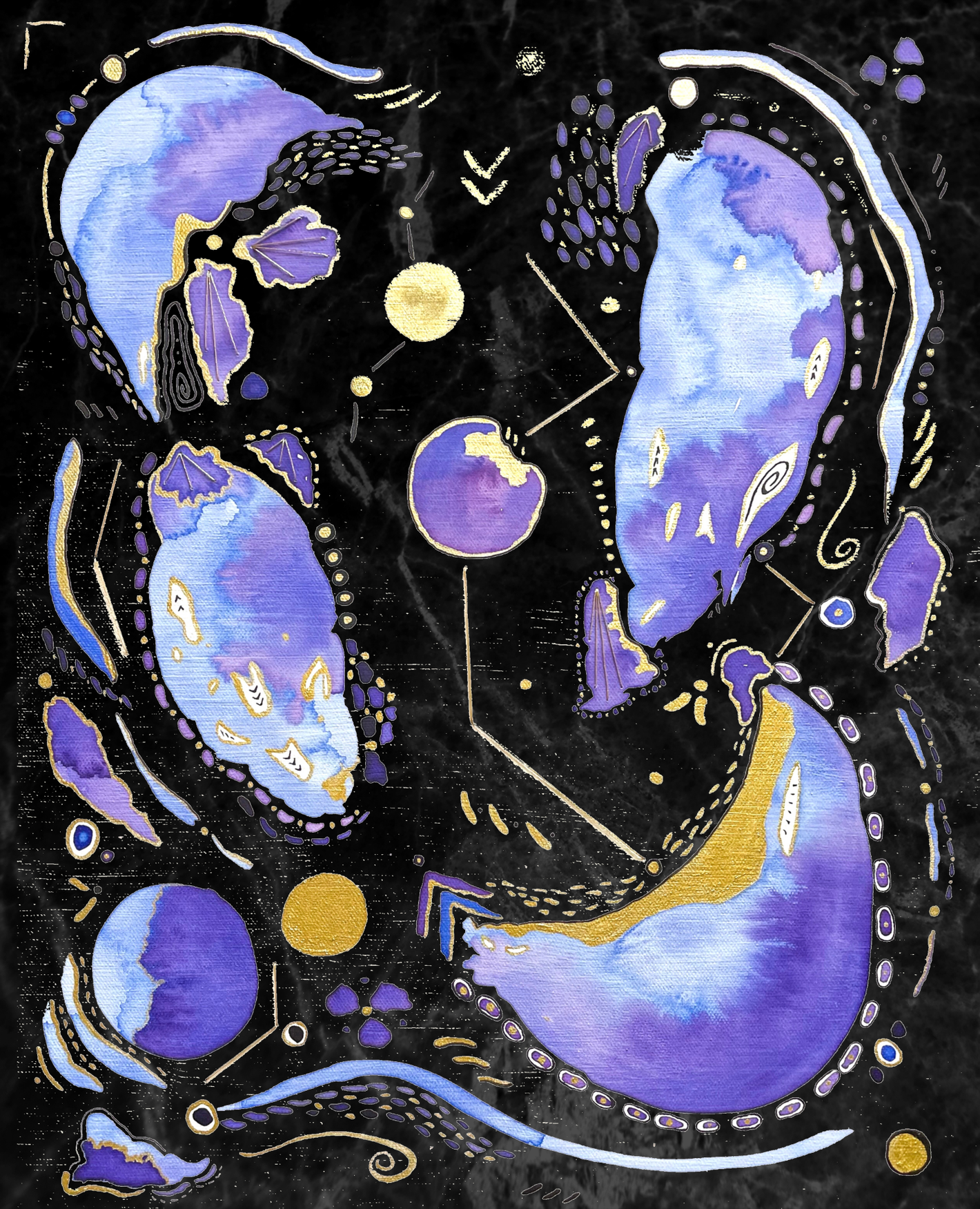
'Cosmic Ocean (Dark'

